
ARI Architecture
Review the architecture behind Ari's inference layers, training data flow, semantic shape graph, and mapping review workflow.
Products / ARI
Ari helps organizations infer, explain, and govern mappings between complex data shapes.
Modern integration work depends on translating between schemas, message formats, partner-specific payloads, APIs, events, files, and canonical domain models. That translation is usually built by hand: experts inspect both sides, identify equivalent concepts, reconcile naming differences, encode special cases, and maintain the mapping as systems evolve.
Ari turns that process into an automated inference workflow. It combines structural information with semantic signals such as concept tags, code crosswalks, domain bindings, synonym sets, qualifiers, constraints, and prior mappings to propose candidate relationships between two shapes. Each proposed relationship can be scored, explained, reviewed, refined, and reused.
For technical teams, Ari provides a semantic relation inference engine. For product and executive leaders, Ari reduces the friction of data onboarding, partner integration, canonical model adoption, and large-scale data interoperability.
Review the architecture behind Ari's inference layers, training data flow, semantic shape graph, and mapping review workflow.
Review the formal model for Ari's shapes, relations, evidence, ranking, and globally consistent mapping proposals.
Enterprises struggle because the meaning of its data is fragmented across systems.
The same business concept might appear under different names in different APIs. A message field might depend on a qualifier to reveal what it actually means. A partner-specific EDI segment might map cleanly to a canonical model only when code sets, loop context, and trading-partner conventions are considered together. A legacy transformation might already encode valuable domain knowledge, but that knowledge is often trapped inside scripts, spreadsheets, one-off mapper code, or tribal memory.
Traditional mapping work is slow because it treats these mappings as manual implementation tasks. Ari treats them as semantic inference problems.
Instead of starting with transport details or vendor-specific schemas, Ari starts with shapes, concepts, and relationships. Infrastructure-specific transformations can still be generated or implemented downstream, but the source of truth is the inferred and governed semantic relation model.
Ari infers candidate mappings between source and target shapes.
A shape can represent many kinds of structured data:
Ari analyzes those shapes as graph-like semantic structures. It considers hierarchy, cardinality, field names, types, constraints, segment context, code sets, qualifiers, and explicit semantic annotations. It then proposes relation edges between source and target nodes.
Those relation edges can represent direct field mappings, concept-level equivalence, value-level transformations, qualifier-dependent mappings, structural projections, or richer relationships that need review before operational use.
The result is not a black-box mapping. Ari produces candidate relations with confidence, supporting evidence, and traceable rationale.
Ari is built around a semantic shape graph.
At the base layer, Ari models each side of a mapping problem as a structured shape: nodes, fields, hierarchy, types, constraints, paths, and cardinality. On top of that structure, Ari attaches semantic annotations: concept tags, domain bindings, synonym expansions, code mappings, value hints, role information, and known relationship patterns.
Inference then combines multiple signals:
Ari uses those signals to generate, rank, and explain candidate relation edges. A reviewer can accept, reject, constrain, or refine those edges. Confirmed knowledge becomes part of the reusable semantic asset base, improving future inference across related systems and partners.
For a deeper technical breakdown, see Ari Architecture and Ari Formalization.
Ari gives integration, data, and platform teams a repeatable way to convert domain knowledge into governed mapping intelligence.
Core outputs include:
This helps teams reduce manual mapping effort, shorten onboarding cycles, preserve institutional knowledge, and make integration logic easier to inspect and evolve.
EDI modernization is one of Ari's primary proving grounds.
EDI mapping is difficult because meaning is rarely located in a single field name. It is distributed across transaction sets, loops, segments, qualifiers, code values, partner conventions, and domain context. A field can mean different things depending on where it appears and which qualifier accompanies it. Two partners can express the same business concept using different structures or codes.
Canonical models are usually more explicit than EDI payloads, but connecting the two requires deep knowledge of both sides.
Ari is designed for this kind of problem.
It can use semantic assets such as EDI concept tags, qualifier interpretations, code mappings, transportation vocabulary, canonical model bindings, and prior partner mappings to infer relationships between EDI structures and canonical domain models. Instead of rebuilding the same mapping logic partner by partner, teams can reuse confirmed semantic knowledge and rerun inference as schemas evolve.
For EDI programs, Ari can support:
The Ari schema matching studio provides workspaces to:
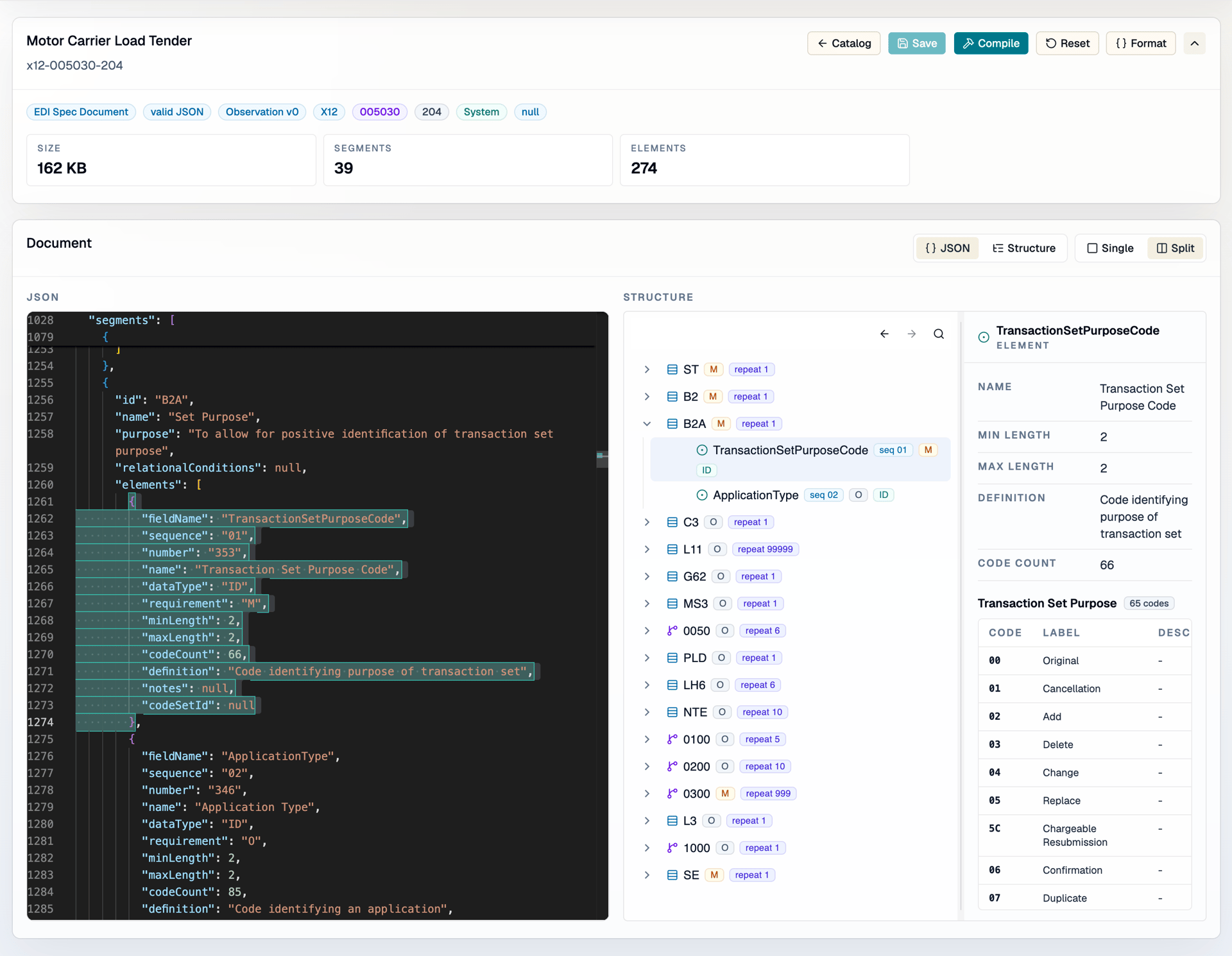
Ari is useful wherever organizations need to map complex data shapes repeatedly and reliably.
Typical initiatives include:
Ari does not replace domain experts. It amplifies them. Experts provide the semantic hints, review the inferred candidates, and govern the resulting relation model. Ari makes that knowledge systematic, explainable, and reusable.
Ari is developed alongside the Cohesive semantic toolchain and is built on the same architectural stance: define the semantics first, then attach infrastructure-specific interpretations.
The underlying relation model comes from Cohesive.Relations. Ari adds automated inference, training workflows, semantic shape graph enrichment, and product workflows around review, explanation, and reuse.
This separation matters. It means Ari is not just a mapper for one transport or one vendor. It is a semantic inference system that can be projected onto concrete integration infrastructure after the relationship model is understood.
Ari is designed for organizations where integration work is strategically important but operationally expensive.
The expected impact is:
For executives, Ari turns mapping knowledge into an asset rather than a recurring services cost. For product managers, it creates a clearer path from customer or partner requirements to operational integration. For architects and engineers, it provides a semantic layer that can be inspected, extended, tested, and projected into concrete systems.
If your organization already has canonical models, partner specs, code crosswalks, glossaries, mappings, taxonomies, ontologies, or integration playbooks, Ari can help turn that knowledge into inferred, explainable, reusable relations.